

Fishing nets: ghosts in our oceans
The global fishing industry is based on an ancient and technologically impressive tool: the fishing net. However, what was once a biodegradable piece of equipment has become one of the most persistent pollutants found worldwide. The issue of abandoned fishing nets, or “ghost nets”, is now at the heart of concerns about the marine environment.
Fishing nets: from natural fiber to everlasting plastic
For millennia, people fished with nets made from renewable materials such as flax, hemp, cotton, or even roots. They offered a major environmental advantage: if they were lost at sea, they would break down naturally in a few months.
But everything changed when fishing industrialized after the Second World War. To meet growing demand and increase profitability, natural fibers were replaced with synthetic polymers (such as nylon, polyethylene, and polypropylene). These new materials revolutionized the sector, offering:
- Increased strength: they can support catches weighing tons without breaking.
- Unrivaled light weight: this allows vast nets (of up to several kilometers in size) to be used.
- Lower cost: this makes it easier to replace nets frequently.
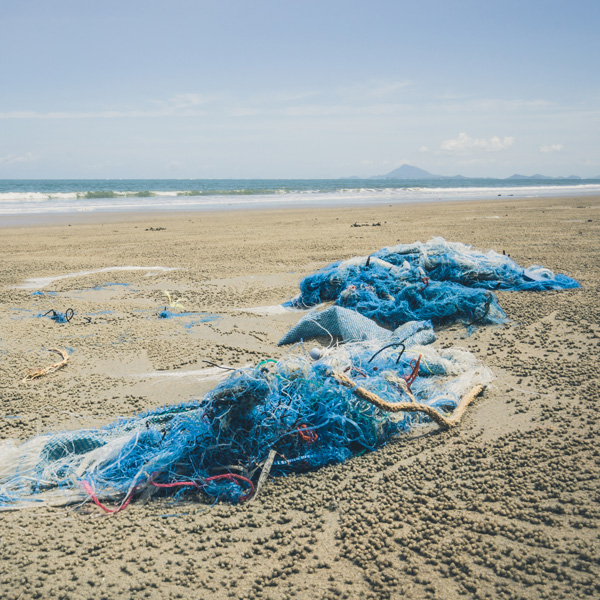
Today, methods vary from region to region, from the immense bottom trawls used by industrial fleets to the gillnets used by artisan fishers. But their exceptional lifespan is a poisoned chalice. A modern net never truly breaks down. Instead, it fragments into microplastics, which remain within the ecosystem for centuries.
How have fishing nets become an environmental threat? The transition from biodegradable materials to indestructible plastic led to the current crisis of “ghost nets”.
Every year, between 500,000 and 1 million tons of fishing nets and gear are lost or abandoned in the water
The scale of the phenomenon is difficult to measure accurately, but the indicative figures shared by international organizations (including the FAO and Greenpeace) are shocking. Fishing gear makes up an estimated 10% of plastic waste in the sea.
Mind-boggling figures
Every year, between 500,000 and 1 million tons of fishing nets and gear are lost or abandoned in the water. To put that in more understandable terms, it’s the equivalent of dumping more than 50 Eiffel Towers into the oceans every year. What’s even more striking is that estimates suggest 6% of all fishing nets used, 9% of lobster and crab traps, and 29% of fishing lines end up in the sea.
Fishing net pollution hotspots
Where are these plastic graveyards found?
- The Great Pacific Garbage Patch: this is where the highest levels are found. According to estimates, fishing nets account for nearly 46% of the total weight of this vast agglomeration of waste.
- Intensive fishing areas: such as the Gulf of Mexico, the North Sea, and the coasts of West Africa.
- Coral reefs and seamounts: the currents and the topography catch nets, transforming them into permanent deadly traps.
Fishing gear and nets aren’t just carelessly tossed overboard—they’re often lost in storms, after being caught on rocks, or following conflicts between vessels.
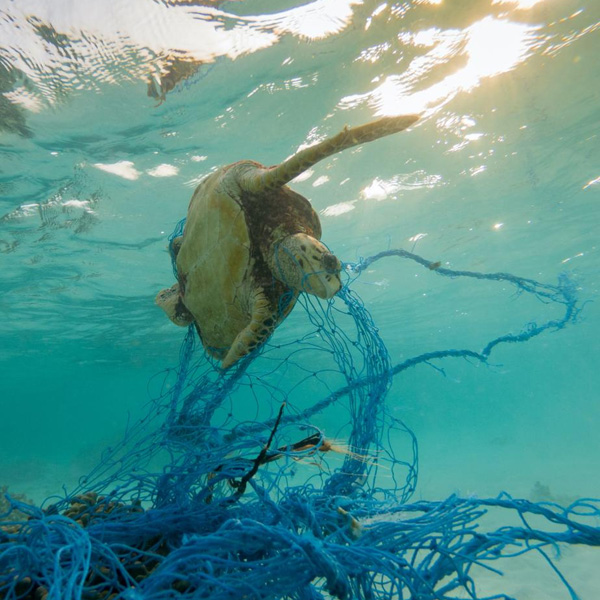
A nylon fishing net is estimated to have a lifespan of 600 years in seawater
The impact on marine plant and animal life
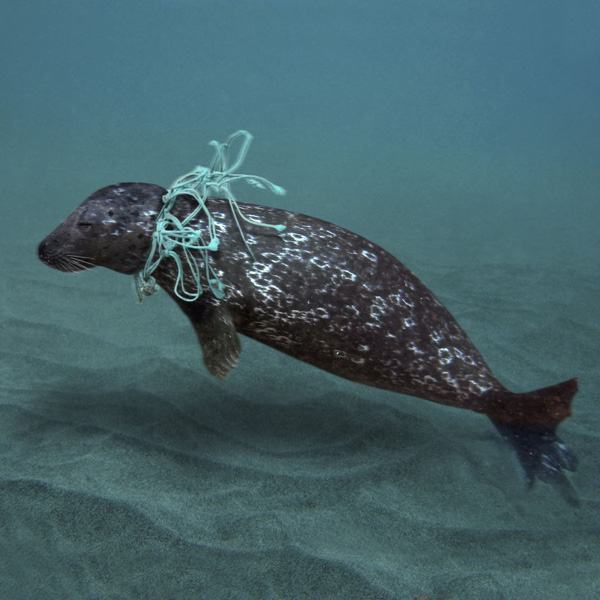
When a net is lost, it doesn’t stop catching fish. That’s why they’re known as “ghost nets”. They keep on capturing, suffocating, and killing without any human intervention.
A deadly trap for biodiversity
The consequences for marine wildlife are tragic:
- Suffocation and drowning: Marine mammals (such as dolphins, whales, and seals) and turtles need to come to the surface to breathe. When they become trapped in nets, they suffocate in atrocious conditions.
- Mutilation: Nets wrap around fins, causing serious infections or preventing animals from feeding.
- Habitat destruction: Weighted nets are dragged along the seabed, scraping against coral reefs and breaking structures that took centuries to grow.
How long does it take for a fishing net to break down?
This is where the real danger lies. A nylon fishing net is estimated to have a lifespan of 600 years in seawater. For six centuries, it will continue to float, trapping wildlife and slowly breaking down into microparticles that enter the food chain, sometimes ultimately finding themselves on our plates.
Fishing gear makes up around 10% of plastic waste in the sea
The environmental impact
Is the environmental impact of fishing nets irreversible?
Without strict worldwide management of gear recycling and without innovation to develop biodegradable materials, ghost nets will continue to haunt our oceans long after we have stopped using them.
In conclusion
Fishing nets are a source of pollution it will be difficult to free ourselves from, and above all, they represent a permanent danger to the marine life that they trap, suffocate, and mutilate.
It’s high time to put strong measures in place to remove this waste from the sea. These measures need to be complementary and supported by innovative, environmentally friendly technology to take action at multiple levels.
Removing this waste from our seas as quickly as possible is crucial so its wildlife can be left in peace.